
Urban political ecology has been an ongoing area of focus. My postdoctoral research at El Colegio de México centres on the spatial production of large economic groups, particularly those involved in tourism on the Yucatán Peninsula. The Critical Geography Collective has served as a forum for reflection based on anti-extractivist practice in Ecuador.
On this page, you will find information and publications relating to each of these perspectives.
ONGOING PROJECT

The spatial production of capital
The Wealth and Space project (2023–2027) offers a comparative analysis of how major economic groups in Brazil, Mexico and Chile shape the built environment. For El Colegio de México, tourism is the key sector, particularly on the Yucatán Peninsula. This has led to two levels of analysis: a national and international examination of Mexico’s top 10 economic groups, and a study of the peninsula’s tourist areas and their new interconnecting infrastructure, such as cruise ports and the new railway. This approach allows us to rethink political ecology from the perspectives of political economy, multi-scalarity and the long timeframes of extractive cycles.
2026
The Extractive Industries and Society
Science Direct
Money, meaning, and territory: family business groups and agro-extractive systems in Latin America
The first comparative article published provides a national overview of some of the major family-owned economic groups in the agro-extractive sector.
2026
Teoría y Praxis
Universidad Autónoma de Quintana Roo
The production of nature under neoliberal tourism: new infrastructure and ‘green’ businesses in Quintana Roo
The first article on the peninsula, currently in print, analyses the new forms of accumulation arising from the opening of new tourist roads leading from the stations of the new railway line, and the economics of sargassum processing.
Urban Political Ecology
Building on my Master’s thesis on the construction of the new Quito airport on agricultural and community land, the intersection between infrastructure megaprojects, urban growth and socio-environmental conflicts in Latin America has been a recurring area of interest.

Rurban Communities of Quito: Between the Entrepreneurialism and the Right to the City.
Peripheral Urban Space and the Social Construction of Risk in Intermediary Cities.
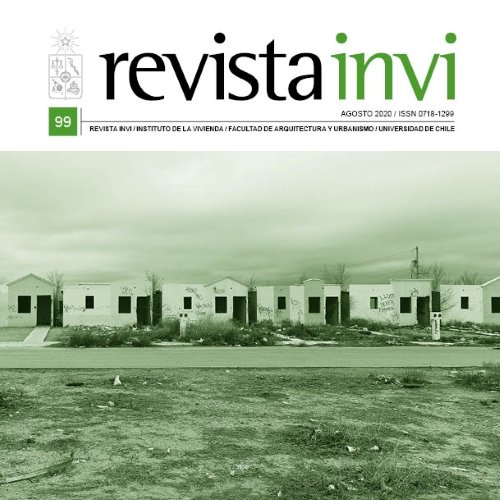
Social Housing in Ecuador: Territorial violence, Constestations and Peripheral urban space production.
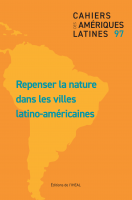
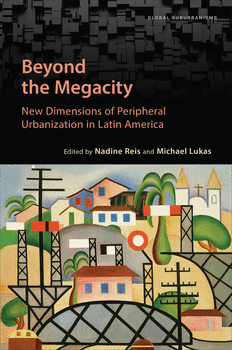
Planetary Urbanization, Agro-Exports, and Informality: Making Sense of the Expanding Peripheries and Emerging Cities.
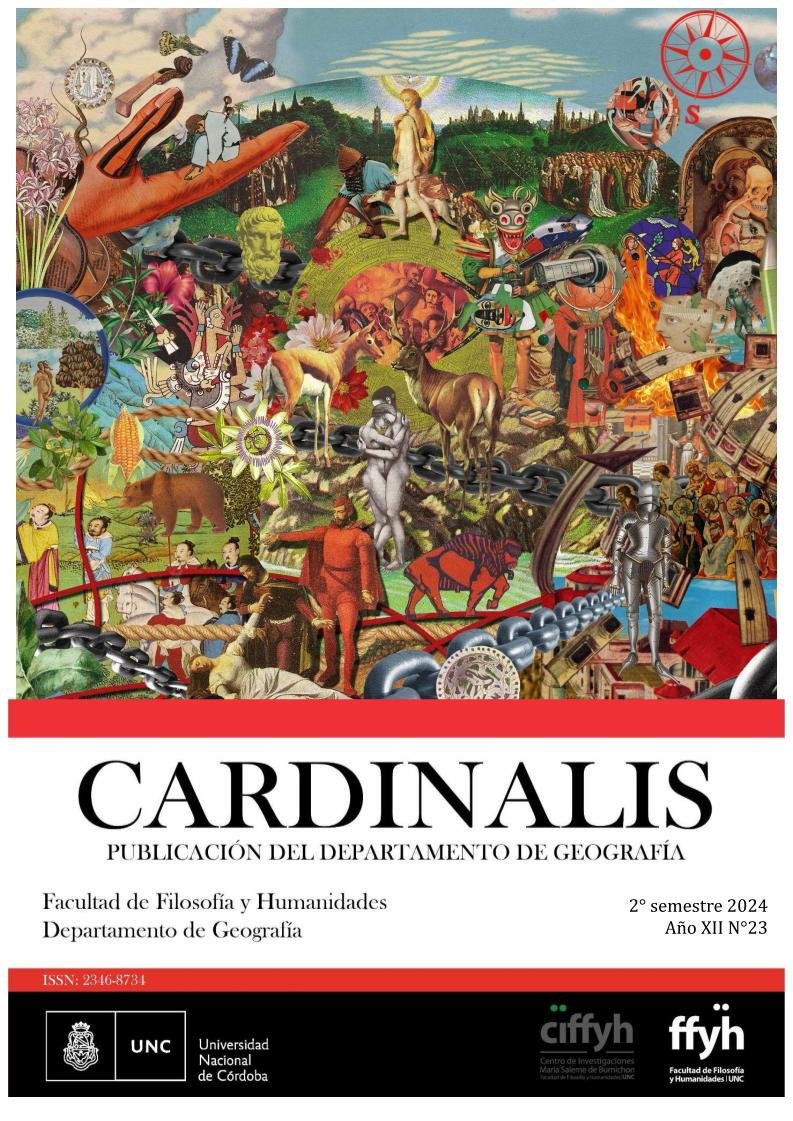
Origins, fluctuations, challenges and possibilities of Latin American urban political ecologies.
ECUADORAN CRITICAL GEOGRAPHY COLLECTIVE
Anti-extractivist political ecology
The collective was formed in 2012 amidst the development of activist cartography, which has its own dedicated section on this website where you can find out more about it.
This section presents some of the theoretical developments arising from the collective’s work, organised into different categories such as specific case studies, generalisations and broader reflections. It also includes reflections on our positionality and the tensions within our academic institutions.
Our interest in generating reflections from multiple theoretical and knowledge frameworks led us to co-organise the 4th Latin American Congress on Political Ecology, held in Quito in 2022.
On the right-hand side, you can view these theoretical contributions, and below are some of the key documents published in academic journals and books on these topics.
Critical territorial nodes in the face of conflict
Latin American political ecology has focused on areas where visible socio-environmental conflicts have erupted. However, there are numerous instances in which extractivist hegemony manages to carry out its spatial production without triggering visible conflict. In order to map Ecuador and analyse spaces where extractive activities are carried out without conflict, our collective has developed the concept of a ‘critical territorial node’, where there is a dialectic between territories with and without conflict.
The Commons versus Buen Vivir
Buen Vivir (or Sumak Kawsay) has, within political ecology, developed a tendency to become an empty signifier. In response to this, the spatiality of the commons and its more dialectical perspective on its internal disputes led us to develop a series of reflections on how to understand the institutional frameworks that territorial actors develop to manage their living spaces.
The Geography of (Im)mobility versus Fixity
The space-time framework of political ecology’s focus on conflict has, on many occasions, meant that consideration has been limited to the duration of socio-environmental conflict and the local scale at which extractivist projects are implemented; this has tended to fix anti-extractivist subjects in both space and time. In response to this, we examine Latin American political ecology through the lens of the importance of mobility, which has enabled us to better understand and support communities facing the risk of eviction due to megaprojects.
Anti-patriarchal insights in the face of extractivism
Latin American political ecology has been generating eco-feminist reflections. As a collective, we have drawn a number of lessons regarding how anti-extractivist struggles need to address their internal inequalities in order to embrace plural territories of life. Furthermore, we believe that processes of coloniality and imposition, even when driven by anti-extractivist sensibilities, can be devastating; we have therefore developed some ecofeminist insights to guide our day-to-day work.
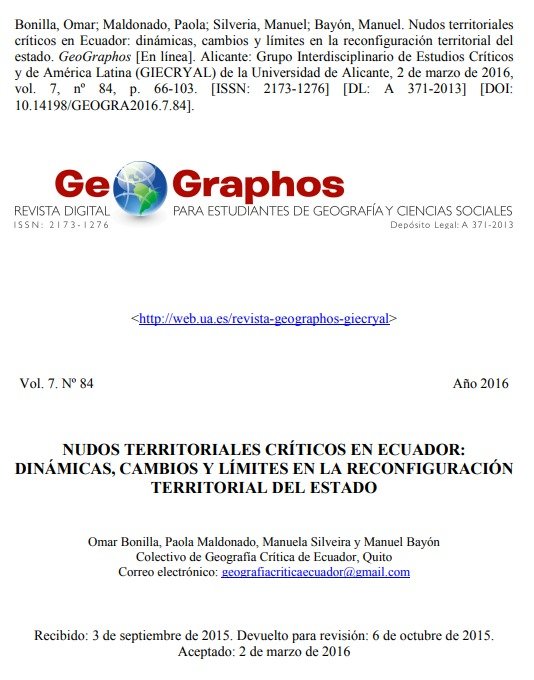
Territorial critical nodes in Ecuador: dynamics, changes and limits of State’s territorial reconfiguration.
Discussion of the multi-scale common from the Territory of the Isolated Peoples.
When subjects move out of place: questioning extractivism and mobility within Latin American Political Ecology.
Imagining Plural Territories of Life: A Feminist Reading of Resistance in the Socio-territorial Movements in Ecuador.
Environmental thought in movement: Territory, ecologisms, and liberation in Latin America.

Eco-Feminisms in Theory and Practice in the Global South: India, South Africa, and Ecuador.
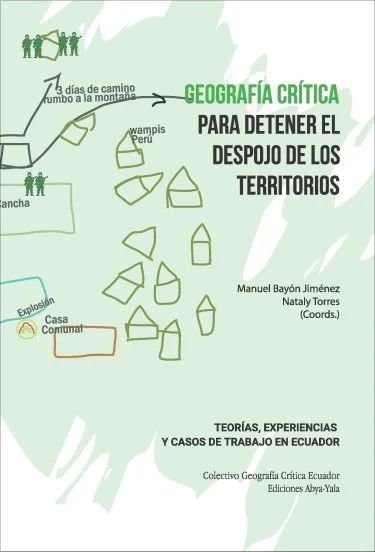
COLLECTIVE’S BOOK
Critical geography to halt the dispossession of territories.
In 2019, we published a book with Abya Yala Press that brings together a range of theoretical, methodological and case-study perspectives at the intersection of critical geography, political ecology and Latin American feminisms. It features a foreword by Carlos Walter Porto-Gonçalves of the Federal University of Fluminense, a critical geographer who is a close friend of the collective and an inspiration for our work.
Co-edited with Nataly Torres, the book has become an inspiring guide for students and professionals in the field of geography, seeking to rethink the discipline in Ecuador, as well as for community and social leaders, who may see critical geography as an ally.
Critical views of the territory from feminism collective
Book: Bodies, Territories and Feminisms
A Latin American compilation of theories, methodologies and political practices.
Between 2013 and 2022, I was part of the ‘Critical Views on Territory from Feminsm Collective’ , where, through the CLACSO Working Group on ‘Bodies, Territories and Feminisms’, we produced a collective volume that introduced concepts such as the ‘re-patriarchalisation of territories’ in extractive contexts, whilst also featuring a wealth of contributions from across the region. Co-coordinated with Delmy Tania Cruz Hernández, for the Ecuadorian and Mexican publishers Abya Yala, Bajo Tierra Ediciones and Libertad Bajo Palabra, it featured a foreword by sociologist Professor Raquel Gutiérrez of the Benemérita Universidad Autónoma de Puebla. The book is also available in an Spanish edition in Mexico and Ecuador, and a Portuguese edition in Brazil.

Manuel Bayón Jiménez
The purpose of this website is to share publications and information on critical-radical geography, Amazonian urbanisation, political ecology, Indigenous resurgence, and activist mapping, as well as to visually present my Curriculum Vitae.