
Urbanization in the Amazon region of Ecuador has been the focus of my doctoral research at the Karlsruhe Institute of Technology and of my primary research activity for more than 10 years, both as a researcher at CENEDET, directed by David Harvey, and as research coordinator at FLACSO-Ecuador, within the Observatory for Amazonian Urbanization.
On this page, you will find information and publications related to each of these stages.
Indigenous disputes over urbanisation
Titled “Indigenous contestations at the frontiers of extended urbanization and rentier capitalism in the Ecuadorian Amazon region,” the doctoral dissertation was completed between 2020 and 2025 through five academic articles and a dissertation that compiled them. Supervised by Professor Michael Janoschka, director of the Institute of Regional Sciences at the Karlsruhe Institute of Technology, the thesis defense panel consisted of Professor Núria Benach of the University of Barcelona and Professor Roberto-Luis Monte-Mor of the Federal University of Belo Horizonte, who awarded the thesis a “Summa Cum Laude” rating. The thesis focuses on combining critical theories from political economy with postcolonial approaches to unravel the forms of dispute surrounding income disparities in the Amazonian peri-urban areas.
Article 1. A climate justice approach to urbanisation processes in the South: Oil axis in Ecuador.
Article 2. Decolonizing Urban Studies from the Amazon: Indigenous Practices to Contest Planetary Urbanization.
Article 3. Residual Urbanization and the Social Relations of Collective Struggle in an Amazonian Kichwa Commune.
Article 4. Rethinking rent gaps from the Amazon: urban contestation and extractive frontiers in Ecuador.
Article 5. Amazonian Indigenous City versus Settler Colonialism: four scenes for cities back.
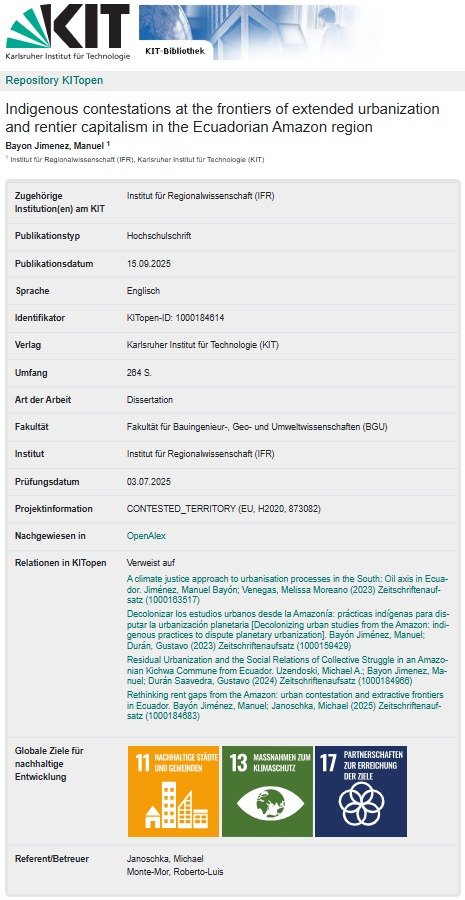
Dissertation. Indigenous contestations at the frontiers of extended urbanization and rentier capitalism.
Megaproyectos de urbanización
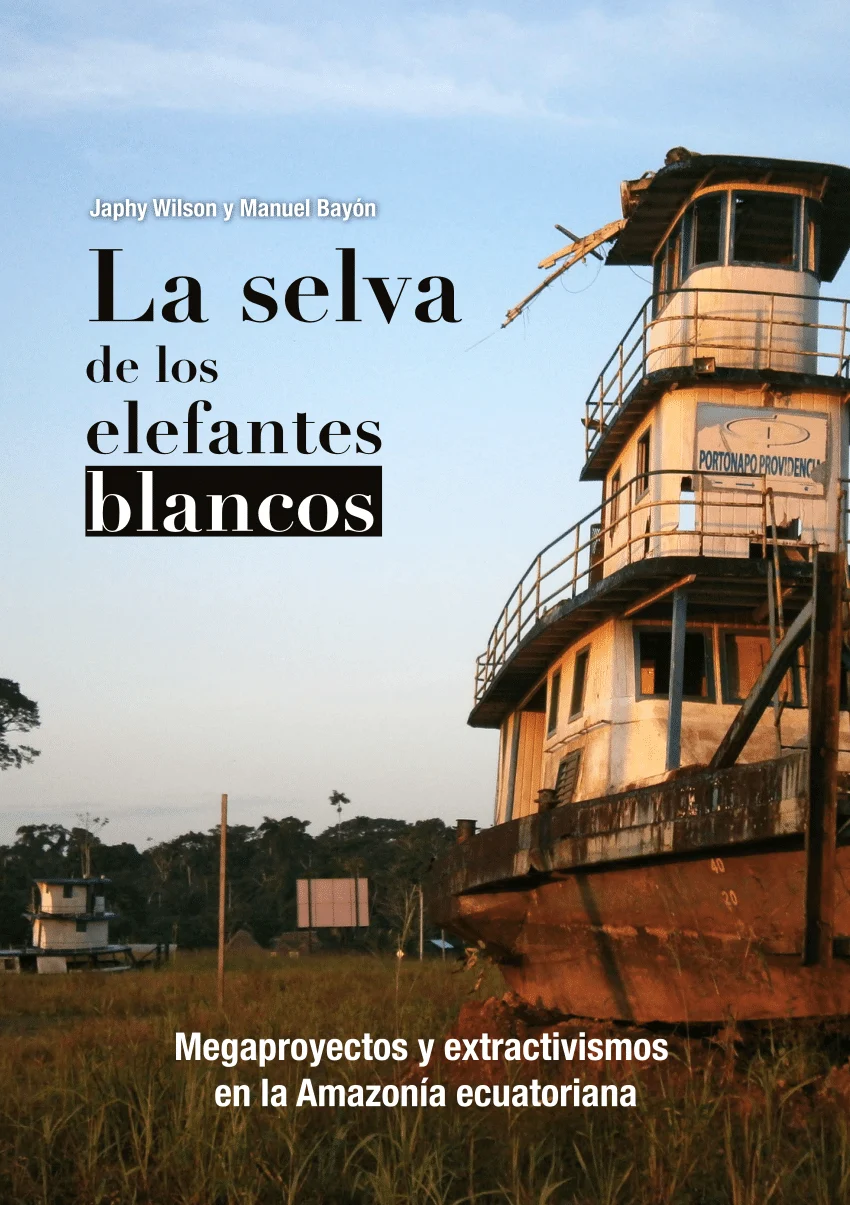
The Jungle of the White Elephants
Honorable Mention for the José Peralta Essay Prize, 2017.
Between 2014 and 2016, the “National Center for Strategy on the Right to Territory” (CENEDET), directed by the British geographer David Harvey, operated at the Institute of Higher National Studies, where I was able to work on the research project “Post-Neoliberalism and Global Urbanization” alongside Japhy Wilson. The result was a book that shared the insights gained from analyzing the Ecuadorian government’s megaprojects in the Amazon, titled *La Selva de los Elefantes Blancos* (The Forest of White Elephants), as well as six research articles related to the various megaprojects, offering innovative perspectives and theoretical proposals.
Post-Neoliberalism and Planetary Urbanization
At CENEDET, we have developed a heterodox Marxist theoretical framework that synthesizes three dimensions: David Harvey’s historical-geographical materialism; Moishe Postone’s theory of value; and Slavoj Žižek’s psychoanalytic critique of ideology. From this perspective, we conceptualize planetary urbanization as a tendency toward the real subsumption of space under capital on a global scale, through which capital is strengthened as an abstract form of domination. This abstract domination is the Real of Capital, which is veiled and disguised by fantasies situated in the gaps of the symbolic universes of dominant ideologies. In the articles, we explore different approaches:
Concrete Jungle: The Planetary Urbanization of the Ecuadorian Amazon.
Post-Neoliberalism and Planetary Urbanization in the Ecuadorian Amazon.
Black hole capitalism: Utopian dimensions of planetary urbanization.
The nature of post-neoliberalism: Building bio-socialism in the Ecuadorian Amazon.
Potemkin Revolution: Utopian Jungle Cities of 21st Century Socialism.
Fantastical materializations: Interoceanic infrastructures.
Residual Urbanisation
Perspectives from Ecuador, Colombia, Brazil, Bolivia, and Peru
Observatory for Amazonian Urbanization
Between 2019 and 2023, I coordinated the research projects “Contested Cities Ecuador” and “Contested Territories Amazonía,” led by Professor Gustavo Durán, in the Department of Economics, Environment, and Territory at FLACSO-Ecuador. Research on working-class neighborhoods in Amazonian cities led to a rethinking of the urban network of the Ecuadorian Amazon and, from there, to the establishment of an observatory to study the phenomenon. Through organizing and participating in conferences, the “Pan-Amazonian Network for Urban-Amazonian Studies” emerged. The concept of residual urbanization has been a key finding of this body of research, which highlights the “non-primary” nature of urban processes in the Amazon, which depend on other, higher-level spatial processes. This perspective has informed the first Pan-Amazonian book on the subject.
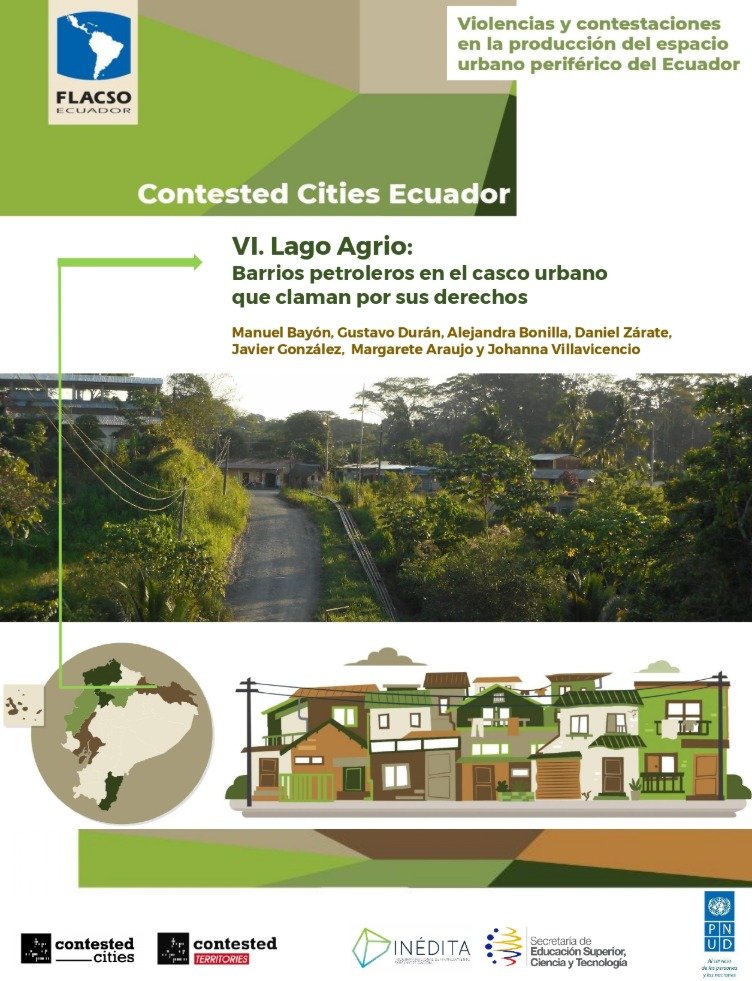
Lago Agrio: Oil-working neighborhoods in the city center demanding their rights.
Living with the daily reality of water pollution: responses to extractive activities in urban peripheries.
An inductive approach to gentrification from the peripheries: between social housing, urban renewal, and extractive enclaves.
Generating and Mapping Amazonian Urban Regions Using a Geospatial Approach
Residual urbanization in the Amazon. A descriptive geography of Ecuador’s network of Amazonian cities.
Residual landscapes on the urban periphery of the Ecuadorian Amazon.
Manuel Bayón Jiménez
The purpose of this website is to share publications and information on critical-radical geography, Amazonian urbanisation, political ecology, Indigenous resurgence, and activist mapping, as well as to visually present my Curriculum Vitae.